Matrix Theory Reference Sheet

Welcome to this comprehensive reference sheet of basic matrix theory. This page covers fundamental matrix definitions, operations, algebraic properties, and the properties of the determinant.
Definitions
To lay down a solid foundation, here are the definitions of fundamental types of matrices that frequently appear in linear algebra.
| Matrix Type | Mathematical Condition | Description / Notes |
|---|---|---|
| Square Matrix | A matrix with the same number of rows and columns. | |
| Diagonal Matrix | A square matrix where all off-diagonal entries are zero. | |
| Identity Matrix | A diagonal matrix with ones on the main diagonal. Acts as the multiplicative identity. | |
| Upper Triangular | A square matrix where all entries below the main diagonal are zero. | |
| Lower Triangular | A square matrix where all entries above the main diagonal are zero. | |
| Symmetric Matrix | ( |
A square matrix that is equal to its transpose. |
| Skew-Symmetric | ( |
A square matrix equal to its negative transpose; diagonal entries must be zero ( |
| Hermitian Matrix | ( |
A complex square matrix equal to its conjugate transpose (the complex analogue of a symmetric matrix). |
| Orthogonal Matrix | ( |
A real square matrix whose rows and columns are orthonormal vectors. |
| Unitary Matrix | ( |
A complex square matrix whose conjugate transpose is its inverse (the complex analogue of an orthogonal matrix). |
Operations
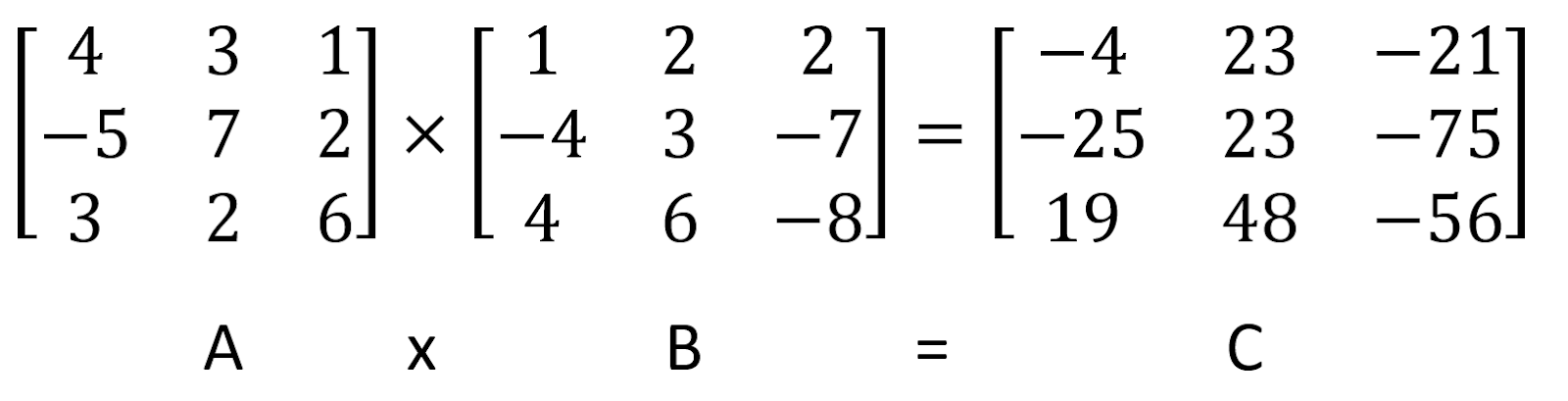
Matrix operations are the foundational building blocks of linear algebra. The table below outlines the most common operations performed on matrices, along with their mathematical notations, definitions, and constraints.
| Operation | Notation / Formula | Description | Constraints & Dimensions |
|---|---|---|---|
| Matrix Addition | Component-wise sum of two matrices. | Same dimensions: |
|
| Scalar Multiplication | Multiplies every element of the matrix by a scalar |
||
| Matrix Multiplication | Standard dot-product of rows of |
Inner dimensions must match: |
|
| Transpose | Swaps rows and columns. | ||
| Conjugate Transpose | Transposes the matrix and takes the complex conjugate of each entry. | ||
| Matrix Inverse | The unique matrix that yields the identity matrix |
Square matrix ( and non-singular ( |
|
| Hadamard Product | Element-wise multiplication of two matrices. | Same dimensions: |
|
| Kronecker Product | Tensor product creating a block matrix where each element of |
||
| Trace | Sum of the elements on the main diagonal. | Square matrix ( |
Properties
Matrix algebra differs significantly from standard scalar algebra, most notably because matrix multiplication is non-commutative. The following table summarizes the key algebraic properties of matrix addition, multiplication, transposes, and inverses.
| Property Category | Mathematical Law / Identity | Description & Notes |
|---|---|---|
| Commutative Law | Addition: Multiplication: |
Matrix addition is always commutative. However, matrix multiplication is strictly non-commutative ( |
| Associative Law | Addition: Multiplication: Scalar: |
Parentheses can be grouped freely for addition, multiplication, and scalar scaling. |
| Distributive Law | Left Distributive: Right Distributive: Scalar Distributive: |
Matrix multiplication distributes over matrix addition from both the left and right sides. |
| Identity & Zero | Identity: Zero Addition: Zero Product: |
|
| Transpose Properties | Involution: Sum: Scalar: Product: |
Note the reversed order in the product transpose: |
| Inverse Properties | Involution: Scalar: Product: Transpose: Hermitian: |
Appliable only to non-singular, square matrices. Note the reversed order in the product inverse: |
| Hermitian Properties | Involution: Sum: Scalar: Product: |
Applies to conjugate transposes over the complex field |
Determinant
The determinant is a scalar value computed from a square matrix that encodes crucial properties of the linear transformation represented by the matrix, such as its volume scaling factor and invertibility.
Fundamental Calculations
For small square matrices, the determinant is calculated as:
Matrix: Matrix (Sarrus' Rule / Cofactor Expansion): Higher Dimensions (
Matrices):
For, the determinant can be calculated recursively using Laplace (Cofactor) Expansion along any row or column :
where
Alternatively, the general Leibniz Formula defines the determinant for any dimension:
where
Core Properties of Determinants
Let
| Property | Mathematical Formula | Description / Notes |
|---|---|---|
| Multiplicative | Generalizes to: |
|
| Transpose | The determinant of a matrix equals the determinant of its transpose. | |
| Conjugate Transpose | The determinant of the conjugate transpose is the complex conjugate of the determinant. | |
| Inverse | Applies if |
|
| Scalar Multiplication | Scaling an |
|
| Determinant of Powers | For any integer |
|
| Singularity & Invertibility | A square matrix is invertible if and only if its determinant is non-zero. | |
| Diagonal & Triangular | If |
|
| Orthogonal Matrix | If |
|
| Unitary Matrix | If |
Effects of Elementary Row Operations
When performing Gaussian elimination, the determinant changes predictably with each type of elementary row operation:
Row Interchanges (Swapping two rows):
Swapping any two rows multiplies the determinant by. Row Scaling (Multiplying a row by a scalar
):
Multiplying a single row by a scalarmultiplies the determinant by . Row Addition (Adding a multiple of one row to another):
Adding a scalar multiple of one row to another row does not change the determinant.
- Title: Matrix Theory Reference Sheet
- Author: Fireflies
- Created at : 2026-06-04 15:42:47
- Updated at : 2026-07-08 07:17:24
- Link: https://fireflies3072.github.io/matrix-theory/
- License: This work is licensed under CC BY-NC-SA 4.0.