LLM-supported 3D Modeling Tool for Radio Radiance Field Reconstruction

Creating 3D Worlds with a Chat: A New Tool for Wireless Research
Imagine designing a complex environment for cutting-edge wireless research just by describing it in a chat. That's the core idea behind a new LLM-supported 3D modeling tool developed to simplify the creation of 3D environments for Radio Radiance Field (RRF) reconstruction. This tool dramatically lowers the barrier to entry for researchers, making it much easier to build the precise 3D scenes needed for next-generation channel modeling.
💡 Status: Submitted to ICC 2026 (Under Review).
📥 Download: Click here to view the Full Paper (PDF)
The Challenge: RRF and 3D Modeling
The Radio Radiance Field (RRF) has emerged as a promising approach for modeling wireless channels. Unlike traditional methods, RRF provides a comprehensive spatial representation of how radio waves propagate, capturing crucial channel parameters like gain, angle of arrival, and delay in a 3D space.
However, accurately reconstructing an RRF, for example with methods like RF-3DGS, traditionally demands an accurate 3D model of the environment. Creating this model usually requires labor-intensive physical measurements and advanced computer vision techniques, which can be a significant hurdle for researchers.
The Solution: An Intuitive, Chat-Based Interface
This new tool addresses the complexity of 3D modeling by integrating locally deployed Large Language Models (LLMs) and generative frameworks with the industry-standard Blender software. The result is an intuitive, chat-based interface that lets users create and manipulate complex 3D models using simple natural language commands.
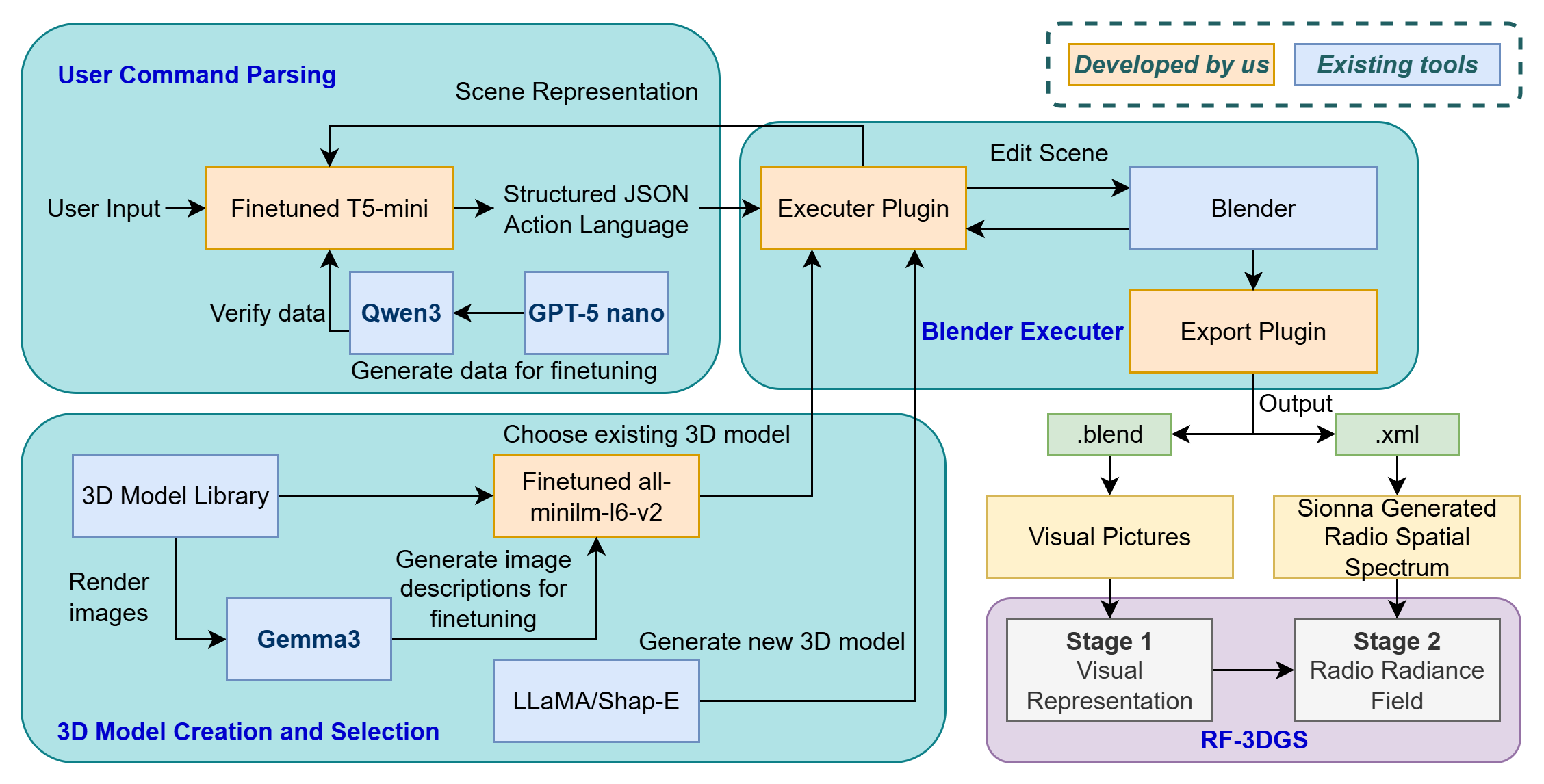
How the Tool Works: The Core Components
The system has three main components that work together to turn a user's text description into a scene ready for RRF reconstruction: natural language parsing, 3D model creation/selection, and output interfacing.
User Command Parsing: This is where natural language meets machine code. A fine-tuned T5-mini model is used to convert the user's chat input (e.g., “Add a nightstand, then put a lamp on it”) into a structured, machine-readable format: a JSON array of action objects. The fine-tuned T5-mini model was chosen for its excellent balance of high accuracy (85.91%) and low computational cost, achieving the best trade-off for a locally deployable tool.
3D Model Creation and Selection: When the system needs an object, it can either create a new 3D model or retrieve one from a local library.
- Creation: Two generative models are available: Shap-E for higher visual quality (slower) and LLaMA-Mesh for faster, text-token-based generation (lower detail). Users can choose based on their need for speed versus fidelity.
- Selection: To find an existing object, the system uses a fine-tuned all-MiniLM-L6-v2 model for semantic search, allowing users to describe the object (e.g., “a vase with a wide base”) instead of requiring a specific file name.
Blender Integration and Output Interfacing: The final step ensures compatibility with the RRF pipeline.
- An Executor Plugin is created as a server in Blender that listens to requests and executes the structured JSON commands, applying the requested modifications to the 3D scene.
- A custom Export Plugin is critical for compatibility. It converts all mesh objects into individual Polygon File Format (PLY) files and generates a single Extensible Markup Language (XML) file that describes the scene structure and material properties, making it ready for the RF-3DGS pipeline.
Real-World Demonstrations
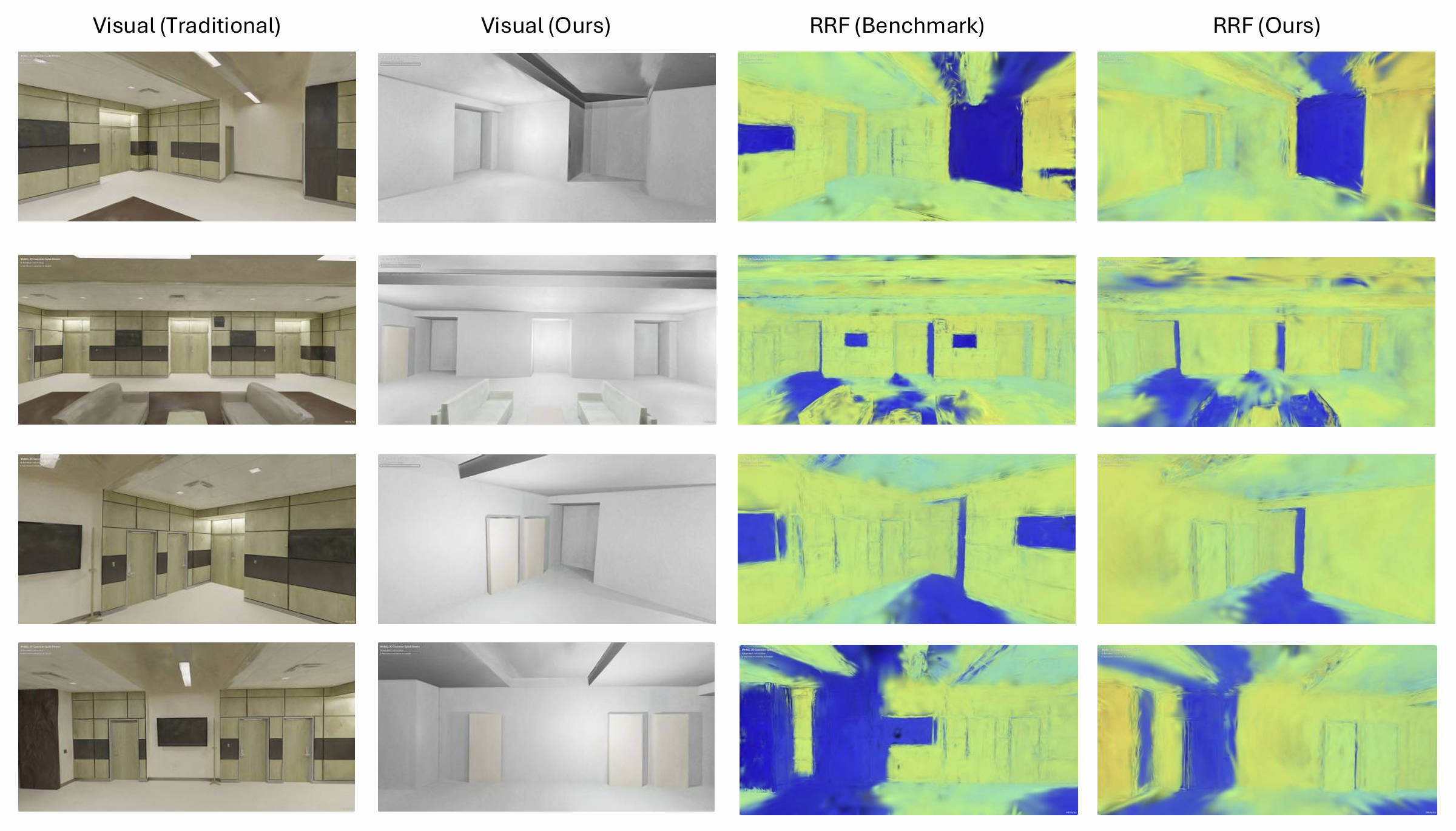
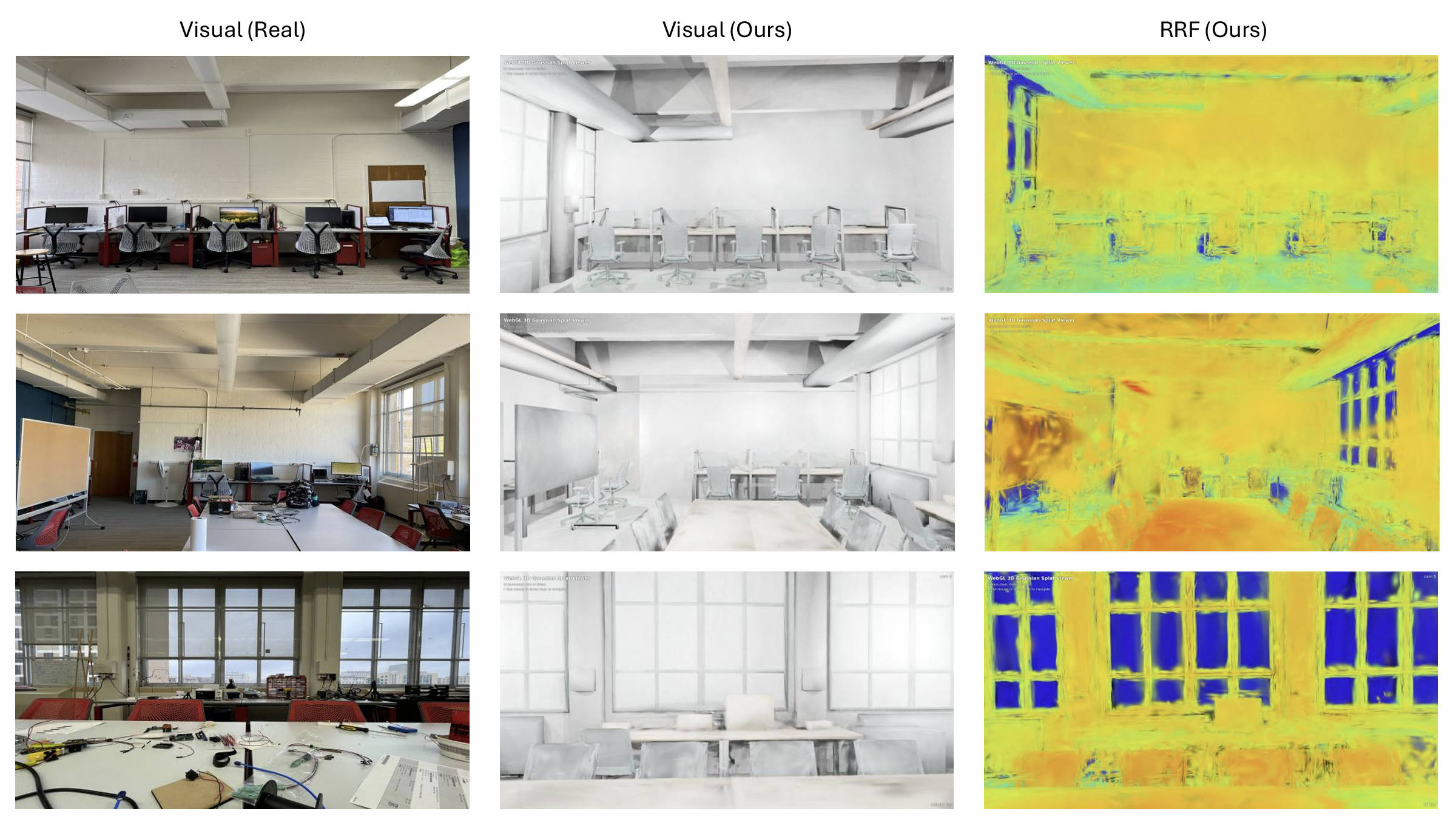
The tool was successfully demonstrated by constructing two complex indoor environments: the NIST lobby and the wireless lab at the University of Wisconsin-Madison (UW-Madison). The system was able to generate scenes that were highly comparable to those built using traditional manual methods.
NIST
UW-Madison
- Title: LLM-supported 3D Modeling Tool for Radio Radiance Field Reconstruction
- Author: Fireflies
- Created at : 2025-03-09 16:51:21
- Updated at : 2026-04-02 08:44:38
- Link: https://fireflies3072.github.io/room-designer/
- License: This work is licensed under CC BY-NC-SA 4.0.